
Selecting the correct mesh size is one of the most important decisions in industrial filtration.
Choose mesh size based on the particle size you need to remove, not the mesh number itself. In most applications, 20–40 mesh is used for coarse debris, 40–100 mesh for general protection, and 100–200 mesh for finer filtration where higher cleanliness is required.
Mesh size directly affects both filtration performance and system operation.
A mesh that is too coarse allows harmful particles to pass through.
A mesh that is too fine can restrict flow, increase pressure drop, and clog quickly.
In practice, the goal is to strike a balance between:
• Particle retention
• Flow capacity
• Maintenance frequency
This is especially important in systems such as pumps, valves, and pipelines, where both protection and efficiency matter.
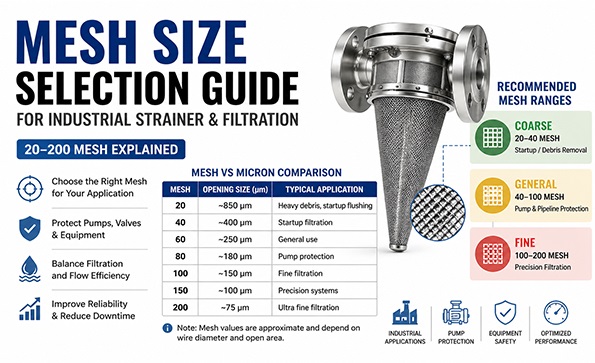
Mesh refers to the number of openings per inch in a screen.
A higher mesh number means smaller openings
A lower mesh number means larger openings
However, mesh is not a direct measurement of particle size. Two screens with the same mesh number can have different opening sizes depending on:
• Wire diameter
• Weaving method
• Manufacturing tolerances
Because of this, mesh values should always be interpreted as approximate ranges rather than exact cut-off points.
The table below shows commonly accepted approximations used in industrial filtration:
| Mesh | Opening Size (μm) | Typical Particle Range | Typical Application |
|---|---|---|---|
| 20 | ~840–850 μm | >800 μm | Heavy debris, startup flushing |
| 40 | ~400–425 μm | 400–800 μm | Coarse filtration |
| 60 | ~250 μm | 200–400 μm | General filtration |
| 80 | ~180 μm | 150–300 μm | Pump protection |
| 100 | ~150 μm | 100–200 μm | Fine filtration |
| 150 | ~100 μm | 75–150 μm | Precision systems |
| 200 | ~75 μm | <100 μm | Very fine filtration |
Note: These values are widely used engineering references. Actual performance may vary depending on screen construction.
1. 20–40 Mesh — Coarse Filtration
Used when large debris is present, especially during system startup.
Typical particles:
• Weld slag
• Rust flakes
• Scale
Advantages:
• Low pressure drop
• High dirt-holding capacity
2. 40–100 Mesh — General Industrial Protection
This is the most commonly used range in industrial systems.
Typical applications:
• Pump protection
• Pipeline filtration
• General process systems
This range offers a practical balance between filtration efficiency and flow performance.
3. 100–200 Mesh — Fine Filtration
Used where smaller particles must be controlled.
Typical applications:
• Chemical processing
• Sensitive equipment protection
• Precision filtration systems
Consideration:
• Higher risk of clogging
• Requires careful monitoring of the pressure drop
A practical selection process usually follows these steps:
1. Identify the Target Particle Size
Start with the size of particles you need to remove.
Choose a mesh with openings smaller than that size.
2. Consider Equipment Sensitivity
Different equipment has different tolerance levels:
Pumps → moderate filtration
Valves → moderate to fine
Precision systems → finer filtration
3. Evaluate Flow and Pressure Drop
Finer mesh increases resistance.
Ensure the system can handle the resulting pressure drop.
4. Account for Debris Load
If debris concentration is high (e.g., during startup), use a coarser mesh to prevent rapid clogging.
5. Match the Operating Stage
| Stage | Recommended Mesh |
|---|---|
| Startup / Flushing | 20–40 |
| Commissioning | 40–80 |
| Normal Operation | 60–150 |
• Choosing mesh by number alone
Mesh without micron context can lead to incorrect selection.
• Using fine mesh during startup
This often causes immediate blockage due to heavy debris load.
• Ignoring pressure drop
Even correct filtration can fail if flow is restricted.
• Over-specifying filtration
Excessively fine mesh increases cost and maintenance without real benefit.
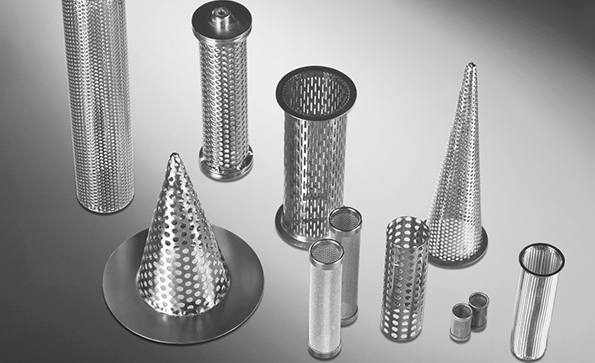
Mesh selection is particularly important for temporary filtration devices such as cone strainers used during pipeline startup.
In most cases:
20–40 mesh is used for initial flushing
40–80 mesh is used for general protection
See full guide: Witches Hat Strainer Guide
1. What is the difference between mesh and micron?
Mesh is the number of openings per inch, while micron measures the actual size of those openings. Mesh is an indirect indicator and must be interpreted with conversion charts.
2. Is higher mesh always better?
No. Higher mesh provides finer filtration but increases pressure drop and clogging risk.
3. What mesh is commonly used in industrial strainers?
40–100 mesh is the most widely used range for general protection.
5. Can mesh size affect system performance?
Yes. It directly impacts flow rate, pressure drop, and maintenance frequency.
Mesh size selection is not simply about choosing a number, it is about understanding the relationship between particle size, filtration requirements, and system performance.
For most industrial applications, the 20–200 mesh range covers the full spectrum of needs, from coarse debris removal to fine particle control. Selecting the right mesh ensures effective filtration while maintaining system efficiency and reliability.



