
Cone strainers (witches hat strainers) protect pumps by capturing debris during pipeline startup. They are installed upstream of the pump to prevent particles from entering the impeller, reducing the risk of wear, blockage, and failure.
New or modified pipelines often contain debris such as:
• Weld slag
• Rust and scale
• Construction residues
If these particles enter a pump, they can cause:
• Impeller damage
• Seal wear and leakage
• Flow instability or vibration
• Reduced efficiency or unexpected shutdowns
A temporary filtration step before normal operation is therefore essential.
For a full overview of cone strainer design and use: Witches Hat Strainer Guide
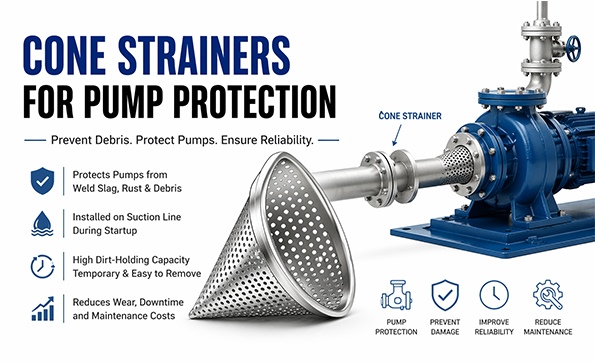
Cone strainers are installed on the suction side of the pump, typically between flanges. Their conical shape provides a large effective filtration area, allowing them to handle high debris loads during commissioning.
Protection mechanism:
• Fluid enters the cone strainer
• Debris is captured by mesh or perforated openings
• Clean fluid flows to the pump
This reduces the risk of solid particles reaching sensitive pump components.
Use a cone strainer for pump protection in the following situations:
• Pipeline startup after installation
• After maintenance or system modification
• Before commissioning new equipment
• Systems with high risk of contamination
Once the system is clean, the cone strainer is typically removed and replaced with a permanent filtration solution if needed.
Learn more → Temporary Strainer VS Permanent Strainer
| Option | Use Case | Limitation |
|---|---|---|
| Cone Strainer | Startup, high debris | Temporary use |
| Y-Strainer | Continuous filtration | Limited debris capacity |
| Basket Strainer | Larger systems | Requires space and maintenance |
Cone strainers are preferred during startup because they can handle large debris loads without frequent cleaning.
Related Reading:
Witches Hat Strainer vs Basket Filter
Correct sizing is essential to avoid flow restriction and cavitation.
Basic rule:
• Open area ≥ 100%–150% of pipe cross-sectional area
• For heavy debris → up to 300% recommended
Why it matters:
• Too small → pressure drop increases
• Too large → unnecessary cost and installation difficulty
Detailed sizing guide → Cone Strainer Sizing Calculation Guide
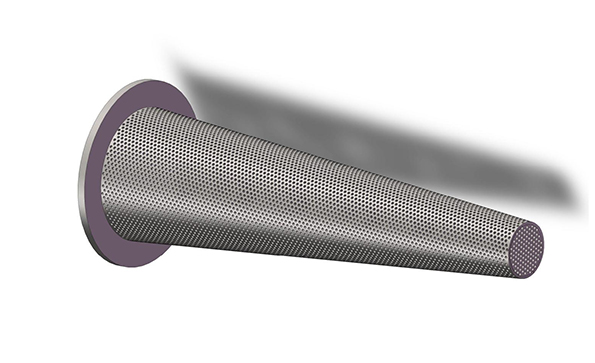
Mesh size determines the level of filtration.
Typical mesh selection for pump protection:
• 20–40 mesh → suitable for removing coarse debris such as weld slag and rust during pipeline startup
• 40–80 mesh → commonly used for general pump protection in industrial systems
• 80–100 mesh → used when finer particles must be controlled, with consideration for pressure drop
Key balance:
• Finer mesh = better filtration
• But also = higher pressure drop
1. Not Installing a Strainer During Startup
This exposes the pump to debris damage immediately.
2. Using a Permanent Strainer Instead
Y-strainers may clog quickly under heavy debris load.
3. Incorrect Installation Direction
Flow direction must follow design to avoid structural damage.
Details → Witches Hat Strainer Flow Direction
4. Leaving the Cone Strainer Installed Too Long
As debris accumulates, pressure drop increases and may affect pump performance.
• Install on pump suction line
• Ensure correct flow direction (cone tip orientation)
• Verify flange compatibility
• Monitor pressure drop during operation
• Remove after system is clean
1. Do I need a strainer before a pump?
Yes, especially during startup. It prevents debris from damaging internal components.
2. Where should a cone strainer be installed?
On the suction side of the pump, before fluid enters the pump.
3. How long should a cone strainer be used?
Only during startup or flushing. It should be removed once the system is clean.
4. What material is best for pump protection strainers?
SS304 for general use, SS316 for corrosive environments, and duplex steel for high-pressure or harsh conditions.
Learn more: Cone Strainer Material Selection Guide
Cone strainers play a critical role in protecting pumps during the most vulnerable phase of operation—startup. By capturing debris before it reaches the pump, they reduce wear, prevent failure, and improve system reliability.
Selecting the correct size, mesh, and installation method ensures optimal performance and minimizes operational risks.
Contact us to obtain custom-designed cone strainers.
Email: sales@yubofilter.com
WhatsApp: 86 136 5328 5589



