
Choose a basket strainer for high-flow, high-debris, or continuous systems requiring easy maintenance. Choose a Y-strainer for compact, high-pressure, low-debris applications where space and cost efficiency matter.
In industrial pipeline filtration, selecting the wrong strainer can increase pressure loss, maintenance frequency, and operational downtime. Choosing the right pipeline filter is crucial.
The difference comes down to capacity, pressure handling, installation space, and maintenance frequency:
• Basket strainers prioritize high flow capacity and low pressure drop
• Y-strainers prioritize compact design and high-pressure resistance
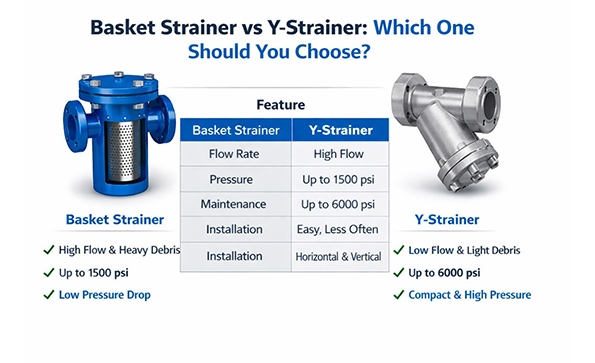
| Feature | Basket Strainer | Y-Strainer |
|---|---|---|
| Best Application | High flow, heavy debris | Low flow, low debris |
| Pressure Handling | Up to ~1500 psi | Up to ~6000 psi |
| Filtration Capacity | High (large basket volume) | Low (small screen) |
| Pressure Drop | Low | Moderate to high |
| Installation | Horizontal only | Horizontal & vertical |
| Space Requirement | Larger footprint | Compact |
| Maintenance | Less frequent, easy cleaning | More frequent cleaning |
| Cost | Higher initial cost | Lower initial cost |
These differences directly impact system efficiency, maintenance cycles, and lifecycle cost.
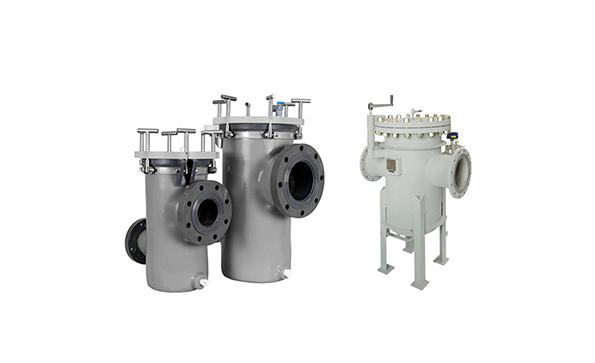
A basket strainer is designed for maximum debris retention and flow efficiency.
Key Advantages:
• Large dirt-holding capacity → reduces cleaning frequency
• Lower pressure drop → improves energy efficiency in high-flow systems
• Easy maintenance → top-access design simplifies cleaning
• Continuous operation options → duplex designs allow uninterrupted flow
Limitations:
• Requires more installation space
• Typically installed in horizontal pipelines only
Best Use Cases:
• Cooling water systems
• Wastewater treatment
• Chemical processing
• Oil & gas liquid pipelines
A Y-strainer is built for compact, high-pressure environments.
Key Advantages:
• Handles high pressure (up to ~6000 psi)
• Compact design → ideal for tight installation spaces
• Flexible installation → horizontal or vertical pipelines
• Lower upfront cost
Limitations:
• Smaller filtration area → more frequent cleaning
• Higher pressure drop in high-flow conditions
Best Use Cases:
• Steam systems
• Gas pipelines
• HVAC systems
• Pump and valve protection
1. Flow Rate
High flow → Basket strainer
Low flow → Y-strainer
2. Debris Load
Heavy solids → Basket strainer
Light particles → Y-strainer
3. Pressure Requirements
High pressure (>1500 psi) → Y-strainer
Pressure-sensitive system → Basket strainer
4. Installation Space
Limited space → Y-strainer
Sufficient space → Basket strainer
5. Maintenance Strategy
Continuous operation required → Duplex basket strainer
Occasional shutdown acceptable → Y-strainer
In field applications:
Systems with dirty fluids (e.g., cooling tower water) perform significantly better with basket strainers due to reduced clogging
Systems handling steam or clean fluids benefit from Y-strainers due to their compact design and pressure tolerance
A commonly used engineering rule:
If your system clogs frequently, you likely need a basket strainer—not a Y-strainer.
1. Which strainer has a lower pressure drop?
A basket strainer typically has a lower pressure drop due to its larger filtration area.
2. Why do Y-strainers handle higher pressure?
Their compact body and reinforced structure allow them to operate in systems up to ~6000 psi, making them suitable for steam and gas lines.
3. Which strainer is better for continuous operation?
A duplex basket strainer is ideal because it allows cleaning without stopping flow.
4. Are Y-strainers cheaper?
Yes, Y-strainers usually have a lower initial cost, but they may require more frequent maintenance in dirty systems.
Choosing between a basket strainer and a Y-strainer depends on your system conditions, not just cost or size.
Use a basket strainer for high flow, heavy debris, and low pressure drop requirements
Use a Y-strainer for compact, high-pressure, and low-debris applications
Making the right choice improves system reliability, reduces downtime, and lowers long-term operating costs.



