
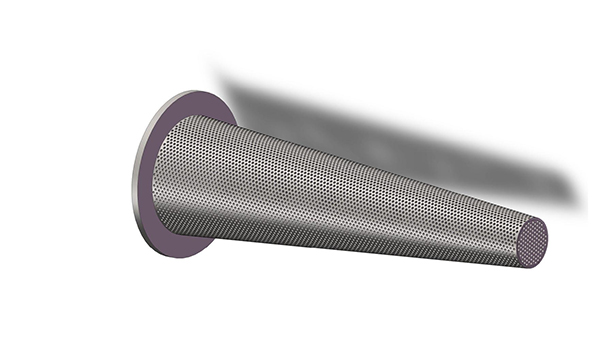
A cone strainer(also known as a witches hat strainer) must be properly sized to ensure effective filtration without restricting flow. Incorrect sizing can lead to excessive pressure drop, reduced system efficiency, and potential equipment damage.
This guide explains how to calculate the correct cone strainer size using practical engineering principles.
Cone strainers are typically used during pipeline startup, where debris such as weld slag, rust, and construction residue must be removed.
If the strainer is undersized:
• Flow restriction increases
• Pressure drop rises quickly
• Debris accumulates faster
If oversized:
• Installation may be impractical
• Costs increase unnecessarily
For a complete overview of how cone strainers work, see: Witches Hat Strainer Ultimate Guide
1. Pipe Diameter
The strainer must match the nominal pipe size (DN or NPS). This ensures compatibility with flange installation.
2. Flow Rate
Flow rate determines how much fluid passes through the strainer. Higher flow requires a larger effective filtration area to avoid excessive velocity.
3. Open Area Ratio (Critical Parameter)
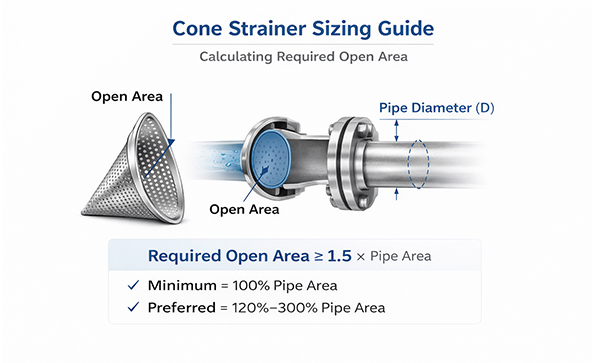
The most important sizing rule is the open area ratio.
Definition:
Open area = total perforation or mesh opening area available for flow.
Recommended Standard:
• Minimum: 100% of pipe cross-sectional area
• Preferred: 150%–300% of pipe area
This ensures smooth flow and minimizes pressure drop during operation.
To estimate the required filtration area:
Required Open Area ≥ 1.5 × Pipe Cross-Sectional Area
Where:
Pipe Area = π × (D/2)²
D = internal pipe diameter
Given:
Pipe diameter = 100 mm
Step 1: Calculate pipe area
Pipe Area ≈ 3.14 × (50²) = 7,850 mm²
Step 2: Apply open area factor
Required Open Area ≥ 1.5 × 7,850 = 11,775 mm²
The cone strainer should provide at least 11,775 mm² effective open area to ensure proper performance.
Unlike flat strainers, cone strainers provide a larger filtration surface due to their shape.
Key advantages:
• Increased effective area
• Improved debris distribution
• Lower risk of clogging
However, the actual usable open area depends on:
• Mesh size
• Perforation design
• Cone angle
Related Reading → Wire Mesh and Perforated Temporary Filter
1. Ignoring Open Area Ratio
Using pipe size alone without checking the open area leads to undersizing.
2. Selecting Too Fine Mesh
Fine mesh reduces open area and increases pressure drop.
3. Not Considering Debris Load
Heavy contamination requires a larger filtration area.
4. Overlooking Pressure Drop
Sizing must balance filtration efficiency and flow performance.
For most industrial applications:
• General pipeline startup → 120% open area
• High debris systems → 300% open area
• Fine filtration → increase area further
In addition:
Use a perforated + mesh combination for strength and efficiency
Ensure proper installation direction to maximize performance
1. What is the standard sizing rule for a cone strainer?
A common engineering rule is to maintain an open area of at least 100%–300% of the pipe cross-sectional area.
2. Can I use the same diameter as the pipe?
Yes, but diameter alone is not sufficient. The effective open area must meet the required ratio.
3. How does mesh size affect sizing?
Finer mesh reduces open area, so a larger strainer surface is required to compensate.
4. What happens if the cone strainer is undersized?
It can cause rapid clogging, increased pressure drop, and reduced system efficiency.
5. Is cone angle important in sizing?
Yes. A steeper cone may reduce the effective filtration area, while a longer cone increases it.
Correct cone strainer sizing is essential for maintaining system performance during pipeline startup. By focusing on open area ratio, flow rate, and mesh selection, engineers can ensure efficient filtration while minimizing pressure loss.
A properly sized cone strainer not only protects downstream equipment but also improves overall system reliability.
For a full technical overview of witches hat strainers, visit: Witches Hat Strainer Ultimate Guide
Learn more about Application → Cone Strainers for Pump Protection



