Selecting the right cone strainer material depends primarily on corrosion resistance, temperature, and pressure conditions.
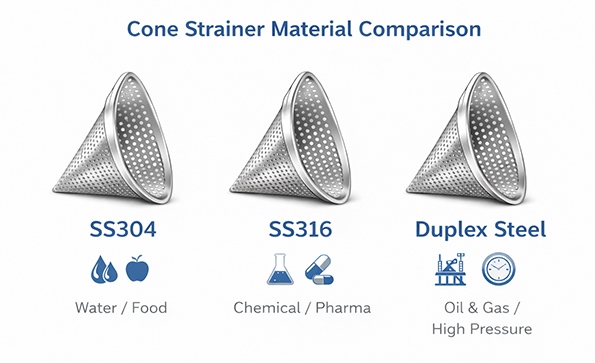
In general, SS304 is suitable for water- and food-grade systems; SS316 is preferred for chemical and mildly corrosive environments; and duplex steel is used for high-pressure and chloride-rich applications such as oil and gas.
Quick selection rule:
Use SS304 for low-corrosion environments, SS316 for moderate corrosion, and duplex steel for high-strength and highly corrosive conditions.
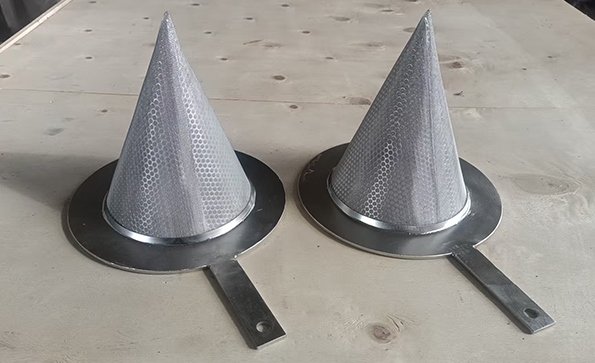
Cone strainers(witches hat strainers) are typically installed temporarily, but they often operate under demanding conditions, such as:
• High flow velocity
• Presence of debris and particles
• Corrosive fluids (water, chemicals, hydrocarbons)
An incorrect material choice can lead to:
• Premature corrosion
• Structural failure
• Contamination of downstream equipment
For a complete overview of cone strainer design and function, see: Witches Hat Strainer Guide
Key characteristics:
• Good general corrosion resistance
• Cost-effective and widely available
• Suitable for clean water and non-aggressive fluids
Typical applications:
• Water systems
• HVAC pipelines
• General industrial use
Limitations:
• Poor resistance to chlorides
• Not suitable for marine or chemical environments
Key characteristics:
• Contains molybdenum (Mo), improving corrosion resistance
• Better performance in chloride environments
• More durable in chemical applications
Typical applications:
• Seawater systems
• Chemical processing
• Oil & gas pipelines
Limitations:
• Higher cost than SS304
Key characteristics:
• Dual-phase microstructure (austenitic + ferritic)
• High strength and excellent resistance to stress corrosion cracking
• Superior performance in harsh environments
Typical applications:
• Offshore platforms
• Desalination plants
• Highly corrosive systems
Limitations:
• Higher cost
• More complex fabrication
| Property | SS304 | SS316 | Duplex Steel |
|---|---|---|---|
| Corrosion Resistance | Medium | High | Very High |
| Chloride Resistance | Low | High | Excellent |
| Strength | Medium | Medium | High |
| Cost | Low | Medium | High |
| Typical Use | General | Chemical | Offshore |
1. Consider Fluid Type
• Clean water → SS304 is usually sufficient
• Saltwater or chlorides → SS316 recommended
• Strongly corrosive fluids → Duplex steel
2. Evaluate Operating Environment
• Indoor or controlled → SS304
• Outdoor or marine → SS316 or Duplex
• Extreme conditions → Duplex
3. Balance Cost and Performance
Material selection should not be based on cost alone.
• Short-term use + low risk → SS304
• Moderate corrosion risk → SS316
• Critical systems → Duplex
4. Consider Duration of Use
Although cone strainers are temporary, in many projects they remain installed longer than expected.
Choosing a slightly higher-grade material can improve reliability and reduce replacement frequency.
1. Using SS304 in Chloride Environments
This often leads to rapid corrosion and failure.
2. Over-Specifying Duplex Steel
Using duplex where SS316 is sufficient increases unnecessary costs.
3. Ignoring Fluid Composition
Even small amounts of chloride or chemicals can affect material performance.
4. Not Considering Mechanical Strength
High flow velocity and debris impact require adequate material strength.
To optimize overall cone strainer performance, material selection should be combined with correct sizing and filtration design: Cone Strainer Sizing Guide
1. Which material is most commonly used for cone strainers?
SS304 is widely used due to its cost-effectiveness, but SS316 is preferred in more demanding environments.
2. Is SS316 always better than SS304?
Not necessarily. SS316 offers better corrosion resistance, but it may not be needed for non-corrosive applications.
3. When should duplex steel be used?
Duplex steel is recommended for offshore, marine, or highly corrosive environments where both strength and corrosion resistance are critical.
4. Can material choice affect pressure drop?
Indirectly, yes. Material affects available design (mesh + perforation), which influences open area and flow performance.
5. How do I balance cost and durability?
Match the material to actual operating conditions rather than over-specifying. This ensures both reliability and cost efficiency.
Material selection is a key factor in the performance and reliability of cone strainers. By understanding the differences between SS304, SS316, and duplex steel, engineers can make informed decisions based on corrosion risk, operating conditions, and budget.
A well-selected material not only ensures effective filtration but also protects the entire pipeline system during critical startup phases.
Explore the complete cone strainer guide here: Witches Hat Strainer Guide
Learn more about Application → Cone Strainers for Pump Protection



