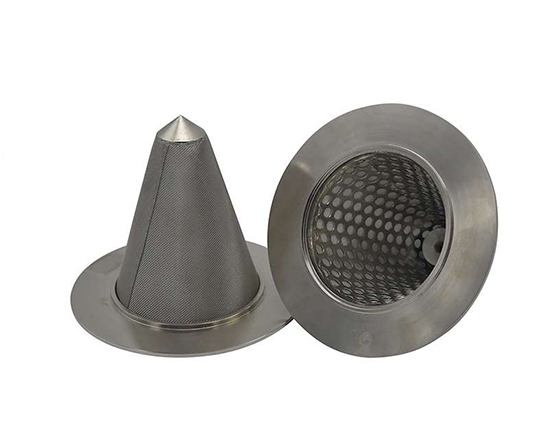
Cone strainers (witches hat strainers) are temporary filters used during pipeline startup to remove construction debris, while Y-strainers are permanent inline filters designed for continuous operation and routine maintenance.
A cone strainer is a conical, temporary filtration device installed between pipe flanges. It captures weld slag, rust, and installation debris during commissioning.
Key traits:
• Temporary use (startup or commissioning)
• High dirt-holding capacity
• Installed between flanges
• Available in mesh, perforated, or hybrid designs
Learn more: Witches Hat Strainer Guide
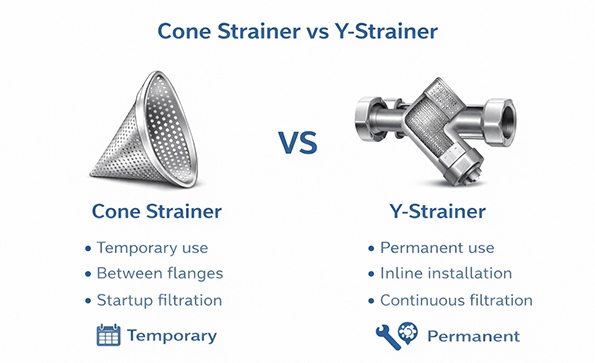
A Y-strainer is a permanent pipeline filter installed in-line, typically with a screen inside a Y-shaped body. It removes particles during normal operation and can be cleaned or replaced.
Key traits:
• Continuous operation
• Inline installation (threaded or flanged)
• Reusable screen (maintenance required)
• Common in water, steam, and oil systems
| Feature | Cone Strainer | Y-Strainer |
|---|---|---|
| Function | Temporary filtration | Continuous filtration |
| Installation | Between flanges | Inline (threaded or flanged) |
| Use Stage | Startup or commissioning | Normal operation |
| Maintenance | Removed after use | Periodic cleaning |
| Dirt Capacity | High (short-term) | Moderate (long-term) |
| Pressure Drop | Low initially, rises with clogging | Stable if maintained |
| Typical Materials | SS304, SS316, Duplex | Cast steel, SS, bronze |
Related Reading: Witches Hat Strainer vs Basket Strainer
Use a cone strainer when the system is new or recently modified, and debris is expected.
Typical cases:
• Pipeline startup after construction
• Equipment protection (pumps, valves, meters)
• Flushing operations
Why it works:
• Large effective area (cone geometry)
• High debris capture capacity
• Simple installation and removal
Use a Y-strainer for ongoing filtration once the system is clean.
Typical cases:
• Water treatment systems
• Steam lines
• Oil and process lines
Why it works:
• Continuous protection
• Cleanable or reusable screen
• Compatible with routine maintenance plans
1. Pressure Drop
Cone strainer: Low at start; increases as debris accumulates
Y-strainer: More stable if cleaned regularly
2. Flow Capacity
Cone strainer: Higher short-term capacity due to larger surface area
Y-strainer: Sized for steady, long-term flow
3. Debris Handling
Cone strainer: Designed for heavy, short-term loads
Y-strainer: Best for lighter, continuous particle loads
Use a cone strainer if:
The pipeline is newly installed
Debris load is high
You need temporary protection during commissioning
Use a Y-strainer if:
The system is in normal operation
Continuous filtration is required
You can schedule periodic maintenance
Combined approach (recommended):
Install a cone strainer during startup
Remove it after flushing
Operate with a Y-strainer for long-term protection
• Using a Y-strainer during startup
This can lead to rapid clogging and frequent shutdowns.
• Leaving a cone strainer installed too long
Temporary strainers are not intended for extended service and may cause a rising pressure drop.
• Ignoring sizing and mesh selection
An incorrect open area or mesh can reduce performance in both types.
Related Reading: Witches Hat Strainer Sizing Selection Guide
1. Can a cone strainer replace a Y-strainer?
No. Cone strainers are temporary; Y-strainers are designed for continuous use.
2. Which has a lower pressure drop?
Initially, a cone strainer may have lower pressure drop due to larger area, but it increases quickly as debris accumulates.
3. Do I need both in one system?
Yes, in many projects: cone strainer for startup, Y-strainer for ongoing operation.
4. How do I select mesh size?
Choose mesh based on target particle size and acceptable pressure drop. Finer mesh requires more open area.
5. What materials should I use?
Match material to the fluid and environment (e.g., SS304 for general use, SS316 for corrosion resistance).
Learn More: Cone Strainer Material Selection Guide: SS304 vs SS316 vs Duplex Steel
Cone strainers and Y-strainers serve different but complementary roles.
Use cone strainers to protect equipment during startup, then switch to Y-strainers for reliable, continuous filtration. Choosing the right device at the right stage improves system performance and reduces maintenance risk.
Learn more about Application → Cone Strainers for Pump Protection



