
Choosing a cartridge filter element is not simply a matter of selecting the smallest micron rating. The right element depends on the fluid, contaminants, required filtration level, flow conditions, temperature, pressure, and material compatibility.
For industrial filtration systems, the element must also match the cartridge filter housing in size, connection, and sealing configuration.
This practical approach can help narrow down the selection of cartridge filter elements before ordering.
The first question is: What needs to be removed from the fluid?
Cartridge filters can be used to remove suspended solids, sediment, process particles, and other contaminants. The required filtration rating should be based on the particle size and the process's cleanliness requirement.
A finer micron rating is not automatically a better choice. If the element is unnecessarily fine for the application, it may increase flow resistance and require more frequent replacement.
Start with the required filtration result, then select an appropriate micron rating.
For example, an application requiring general particle removal may need a different element from one requiring fine polishing filtration.
The process fluid has a direct influence on element selection.
Consider:
• Water and wastewater
• Chemicals and process liquids
• Oils and industrial fluids
• Food and beverage liquids
• Corrosive liquids
The filter media, support material and sealing components should be compatible with the fluid being filtered.
For chemical or corrosive applications, material compatibility should be checked before selecting the element.
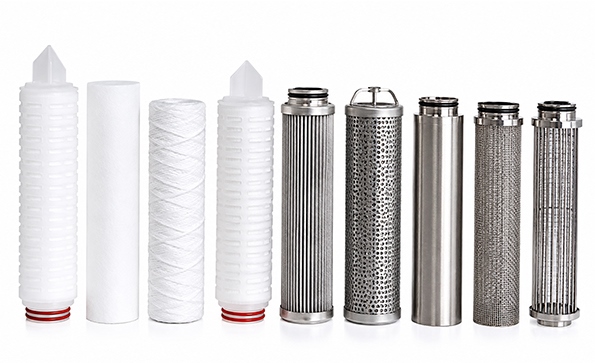
Different cartridge constructions are suited to different filtration requirements. Common options include polymer and metal filter elements.
Pleated filter elements provide a relatively large filtration area and are commonly used where fine liquid filtration is required.
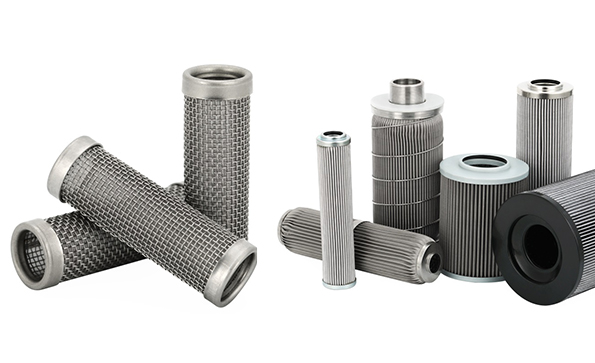
Stainless steel filter elements are suitable when a metal filter structure, mechanical strength, temperature resistance or cleanable construction is required.
Sintered metal filter elements provide a rigid porous structure for applications requiring metal media and robust filtration performance.
Titanium rod filters can be considered for applications where titanium's corrosion resistance and material properties are important.
Wedge wire cartridge filters use a rigid welded V-shaped wire structure and can be suitable for applications requiring durable metal screening and precise slot openings.
The best choice depends on the actual process rather than the material name alone.
Flow requirement is another important selection factor.
A higher process flow may require a larger filtration area, a larger cartridge, multiple cartridges or a suitable high-flow configuration. The filter element should be selected together with the housing rather than treated as a separate component.
For example, a smaller process may use a single cartridge housing, while higher-volume applications may use a multi-cartridge housing with several elements installed in parallel.
Before ordering a cartridge filter element, check the operating conditions of the filtration system.
• Temperature: Make sure the filter media, support structure and seals are suitable for the operating temperature.
• Pressure: Confirm that the element and housing are appropriate for the system's operating conditions.
• Chemical compatibility: Check the compatibility of the filter media, support materials, seals and housing with the process fluid.
These factors become particularly important in chemical processing and other demanding industrial applications.
A cartridge filter element cannot be selected independently from the housing.
For an overview of housing types, configurations and selection factors, see our Industrial Cartridge Filter Housing Guide.
Check the following dimensions and interfaces:
• Cartridge length
• Outside and inside diameter
• End connection
• Sealing configuration
• Number of cartridges
• Available housing space
YUBO supplies cartridge filter housings for different configurations, including single cartridge, multi-cartridge and security filter housings. The element should be compatible with the selected housing before installation.
| Selection Factor | What to Check |
|---|---|
| Fluid | Type and chemical properties |
| Contaminants | Particle type and size |
| Filtration rating | Required micron level |
| Flow | Required process flow |
| Temperature | Operating temperature |
| Pressure | System operating conditions |
| Material | Media and chemical compatibility |
| Housing | Size, connection and sealing |
If several operating conditions are known, they can be used together to narrow down the appropriate cartridge filter element.
YUBO provides cartridge filter elements for different industrial filtration requirements, including pleated, stainless steel, sintered metal, titanium rod and wedge wire configurations.
As a manufacturer, YUBO can also customize element dimensions, connections, materials and configurations according to the application and compatible filter housing.
For a complete filtration system, the cartridge element and housing should be considered as one system rather than two independent products.
1. What micron rating should I choose for a cartridge filter element?
Select the rating according to the particle size and required filtration result. A finer rating is not necessarily better for every application.
2. Can cartridge filter elements be customized?
Yes. Depending on the application, dimensions, materials, connections and configurations can be customized.
3. Can one cartridge element fit different filter housings?
Not necessarily. Cartridge length, diameter, end connection and sealing configuration must match the housing.



