
Industrial cartridge filter housing is a pressure vessel designed to hold one or more filter cartridges for liquid or gas filtration. It is widely used in water treatment, chemical processing, food production, pharmaceuticals, electronics manufacturing, and many other industries where reliable particle removal is required.
Compared with bag filters and strainers, cartridge filter housings provide finer filtration accuracy and more consistent filtration performance, making them one of the most common solutions for industrial process filtration.
A cartridge filter housing is the outer vessel that supports and seals filter cartridges during operation. As fluid passes through the cartridge media, suspended particles are captured while clean fluid exits the housing.
The housing itself does not perform filtration. Filtration efficiency depends on the cartridge filter element installed inside the vessel.
Most industrial cartridge filter housings are manufactured from stainless steel, typically SS304 or SS316L, to provide corrosion resistance, pressure resistance, and long service life.
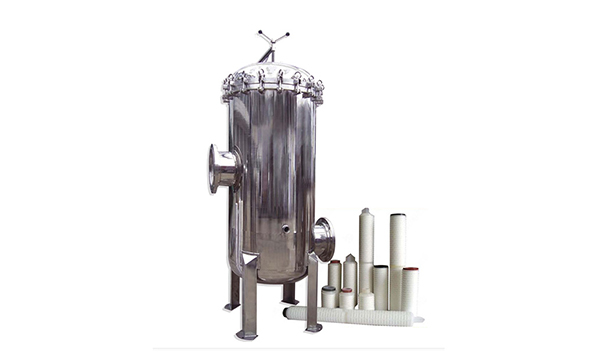
The filtration process is relatively simple.
Process fluid enters the housing through the inlet connection and flows through the filter cartridge. Particles larger than the cartridge's micron rating are retained by the filter media. The filtered liquid or gas then exits through the outlet connection.
A complete cartridge filtration system consists of two key components:
• Cartridge filter housing
Both components must be selected together to achieve the desired filtration performance.
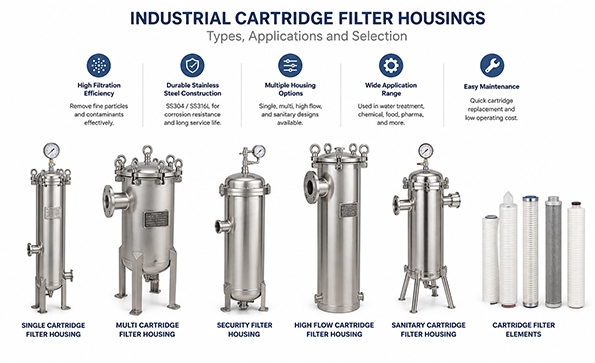
Single cartridge housings are suitable for low-flow applications, pilot systems, laboratories, and small production lines. They are compact, economical, and easy to maintain.
Multi cartridge housings accommodate multiple filter cartridges inside one vessel. They provide larger filtration area and higher flow capacity for industrial operations.
Security filter housings are commonly installed as final-stage filtration systems to protect downstream equipment, membranes, pumps, and process lines.
In-depth Reading:
Single vs Multi Cartridge Filter Housing: Which One Should You Choose?
1. High Flow Cartridge Compatibility
High flow cartridge elements can be installed in specially designed cartridge filter housings to increase flow capacity while reducing the number of cartridges required. This configuration is commonly used in large-scale industrial water treatment and RO pre-filtration systems.
Click here to learn about: Stainless Steel Cartridge Filter for High Flow Liquid Filtration
2. Sanitary Design
For food, beverage and pharmaceutical applications, cartridge filter housings can be manufactured with sanitary connections, polished internal surfaces and hygienic sealing materials to meet process cleanliness requirements.
3. Housing Material
SS304
SS316L
Duplex
4. Connection Types
Threaded
Flanged
Tri-Clamp
5. Cartridge Length
10"
20"
30"
40"
6. Cartridge Quantity
1
3
5
7
21
...
Depending on the application, a cartridge filter housing can be configured with different cartridge quantities, materials, connection types and compatible filter elements to meet specific process requirements.
Both technologies are widely used in industrial filtration, but they serve different purposes.
Cartridge filter housings are generally preferred when higher filtration precision is required, while bag filter housings are often selected for applications with larger particle loading and higher dirt-holding capacity.
In many industrial systems, bag filtration is used as a pre-filtration stage and cartridge filtration serves as the final polishing stage.
In-depth Reading: Bag Filter vs Cartridge Filter
Cartridge filter housings and candle filter systems both use replaceable filtration elements, but they are designed for different operating conditions.
Cartridge filtration is commonly used for routine liquid filtration with relatively low to moderate solids loading. Candle filtration systems are often selected for applications involving higher solids concentrations, pressure filtration, or filter cake recovery.
The choice depends on process objectives, filtration accuracy, and maintenance requirements.
In-depth Reading: Candle Filter vs Cartridge Filter
Cartridge filter housings are widely used in:
• Industrial water treatment
• Reverse osmosis pre-filtration
• Chemical processing
• Petrochemical plants
• Food and beverage production
• Pharmaceutical manufacturing
• Electronics and semiconductor industries
• Fine chemical filtration
Their versatility allows the same housing design to be used with different cartridge materials and micron ratings.
Choosing the correct cartridge filter housing starts with understanding the process conditions.
Key factors include:
1. Flow Rate
Flow rate determines whether a single-cartridge or multi-cartridge filter housing is required. When higher flow capacity is required, high flow cartridge elements may be considered depending on system design.
2. Filtration Accuracy
The required micron rating influences cartridge selection and housing configuration.
3. Operating Pressure and Temperature
Housing design should safely withstand the maximum operating conditions.
4. Housing Material
SS304 is suitable for general industrial use, while SS316L is preferred for corrosive environments and higher purity applications.
5. Connection Requirements
Threaded, flanged, and sanitary clamp connections should match the piping system and industry standards.
Proper housing selection improves filtration efficiency, reduces maintenance frequency, and lowers operating costs.
In-depth Reading: How to Choose a Cartridge Filter Housing
1. What is the purpose of a cartridge filter housing?
A cartridge filter housing provides a sealed pressure vessel that supports filter cartridges and directs fluid through the filtration media.
2. What is the difference between single and multi cartridge housings?
Single cartridge housings contain one filter element, while multi cartridge housings use multiple cartridges to achieve higher flow rates.
3. Which material is commonly used for cartridge filter housings?
SS304 and SS316L stainless steel are the most widely used materials because of their durability and corrosion resistance.
4. Can the same housing use different filter cartridges?
Yes. Depending on the design, a cartridge filter housing can accommodate various cartridge materials, micron ratings, and filtration media.
A cartridge filter housing is a fundamental component of industrial filtration systems. Whether used in water treatment, chemical processing, food production, or pharmaceutical manufacturing, the correct housing design ensures reliable filtration performance and long equipment life.
Understanding housing types, filtration requirements, and operating conditions is the first step toward selecting an efficient and cost-effective cartridge filtration system.
Related Reading:
What Does Cartridge Filter Remove



