
Choosing between a single cartridge filter housing and a multi cartridge filter housing depends on more than flow rate alone. A single housing is typically the best choice for low-flow applications, pilot systems, and installations with limited space. A multi cartridge housing is designed for higher flow capacities, continuous industrial operation, and applications where reducing maintenance frequency is important. Evaluating process conditions, operating costs, and future expansion plans will help determine the most suitable solution.
For a complete guide, visit our Industrial Cartridge Filter Housing Guide.
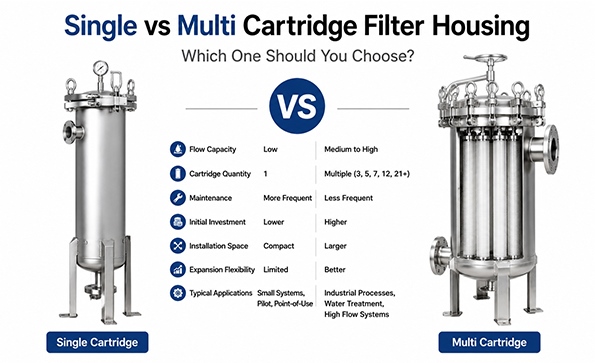
| Feature | Single Cartridge Housing | Multi Cartridge Housing |
|---|---|---|
| Cartridge Quantity | 1 cartridge | Multiple cartridges (e.g. 3, 5, 7, 12, 21 or more) |
| Typical Flow Capacity | Low to medium | Medium to high |
| Installation Space | Compact | Larger, but more efficient for high flow |
| Initial Investment | Lower | Higher |
| Maintenance Frequency | More frequent | Longer service intervals |
| Future Expansion | Limited | Better scalability |
| Typical Applications | Small water systems, laboratories, point-of-use filtration | Industrial water treatment, chemical processing, food & beverage, pharmaceutical production |
Both housing types perform the same function—they hold cartridge filter elements inside a pressure vessel to remove suspended solids from liquids or gases. The main difference lies in the number of cartridges installed and the filtration capacity they provide.
A single cartridge filter housing contains one filter element and is commonly selected for lower flow rates or smaller process systems. A multi cartridge filter housing accommodates several filter cartridges operating in parallel, allowing larger fluid volumes to be filtered while extending service intervals between cartridge replacements.
Rather than asking which housing is better, the more practical question is which one better matches your operating conditions.
Before selecting a cartridge filter housing, review the following process requirements.
1. Flow Rate
Flow rate is usually the first consideration. Lower flow applications generally require only one cartridge, while larger industrial systems often benefit from multiple cartridges working simultaneously.
2. Operating Pressure and Temperature
The housing should be designed to withstand the maximum operating pressure and temperature of the system. Stainless steel 304 and 316L are commonly selected materials for demanding industrial environments.
3. Process Fluid
Water, chemicals, food ingredients and oils all require different material compatibility. Housing material, seals and filter cartridge media should be selected according to the process fluid.
4. Contaminant Load
Applications with higher particle concentrations may require multiple cartridges to increase dirt-holding capacity and reduce replacement frequency.
5. Installation Space
Limited installation space may favor a compact single housing, while larger production lines often have sufficient room for multi cartridge systems.
6. Future Capacity
If production is expected to increase, selecting a housing with additional cartridge capacity can reduce future equipment upgrades.
A single cartridge housing is often the preferred option when simplicity and cost-effectiveness are priorities.
It is well suited for:
• Small water treatment systems
• Laboratory and pilot plants
• Equipment protection before sensitive instruments
• Low-flow chemical dosing systems
• Applications with limited installation space
• Projects with moderate filtration requirements
Because only one cartridge is replaced during maintenance, servicing is straightforward and replacement costs remain relatively low.
A multi cartridge housing becomes more practical as process flow and production demands increase.
It is commonly used for:
• Continuous industrial production
• Municipal and industrial water treatment
• Chemical processing
• Food and beverage manufacturing
• Pharmaceutical production
• RO pre-filtration and utility systems
By distributing flow across multiple cartridges, pressure drop is reduced and cartridges generally last longer before replacement. Although the initial investment is higher, the overall operating efficiency is often better in medium and high-flow applications.
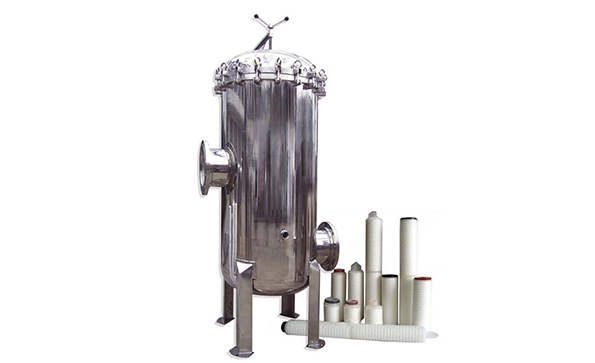
| Factor | Single Cartridge Filter Housing | Multi Cartridge Filter Housing |
|---|---|---|
| Equipment Cost | Lower | Higher |
| Cartridge Replacement | More frequent | Less frequent |
| Maintenance Downtime | More frequent shutdowns | Longer operating cycles |
| Flow Expansion | Limited | Easier to expand |
| Long-Term Efficiency | Suitable for small systems | Better for continuous production |
For facilities operating around the clock, reducing maintenance frequency often delivers greater long-term value than minimizing the initial equipment cost.
In many cases, yes.
Single and multi cartridge filter housings can often accommodate the same cartridge styles, including polypropylene melt blown cartridges, pleated filter cartridges and stainless steel filter elements. The difference is the number of cartridges installed rather than the cartridge design itself.
Selecting the appropriate filter element still depends on filtration accuracy, operating temperature, chemical compatibility and service life requirements.
Standard models meet the needs of many industrial filtration systems, but some applications require customized designs.
YUBO provides custom cartridge filter housing solutions based on specific operating conditions, including:
• Customized cartridge quantities
• SS304 or SS316L construction
• Threaded, flanged or sanitary connections
• Special pressure ratings
• Customized inlet and outlet configurations
• OEM and drawing-based manufacturing
These options allow the housing to integrate more efficiently into existing process systems while meeting project-specific requirements.
When selecting between a single and multi cartridge filter housing, avoid making the decision based only on current flow requirements. Maintenance intervals, future production expansion, available installation space and operating costs should all be considered. In many industrial projects, choosing a housing with moderate capacity reserves can improve long-term system reliability while reducing future modification costs.
Choose a Single Cartridge Filter Housing if you need:
Compact equipment
Lower initial investment
Low to medium flow filtration
Simple maintenance
Laboratory or pilot-scale applications
Choose a Multi Cartridge Filter Housing if you need:
Higher flow capacity
Continuous industrial operation
Longer cartridge service intervals
Better scalability for future expansion
Reduced maintenance frequency
1. Which cartridge filter housing is better?
Neither is universally better. The right choice depends on flow rate, operating conditions, maintenance requirements and available installation space.
2. Can I upgrade from a single housing to a multi cartridge housing later?
Yes. Many facilities upgrade as production capacity increases, although piping and installation requirements should also be evaluated.
3. Does a multi cartridge housing always have higher filtration efficiency?
No. Filtration efficiency is primarily determined by the filter cartridge. A multi cartridge housing mainly increases flow capacity and dirt-holding capability.
4. How do I know which housing size is suitable?
Consider the required flow rate, process pressure, operating temperature, filtration micron rating and expected maintenance interval. If the application is unique, a customized housing may provide the most practical solution.
Whether you need a compact single cartridge housing or a high-capacity multi cartridge filtration system, selecting the correct configuration can improve filtration performance and reduce operating costs. YUBO offers standard and customized stainless steel cartridge filter housings designed to meet different industrial process requirements, with engineering support to help match the right solution to your application.
Related Reading:



