
Chemical plants operate under demanding conditions where filtration components must withstand high temperatures, pressure fluctuations, corrosive media, and continuous operation. Among vessel internals, wedge wire reactor support grids have become a preferred solution for addressing complex filtration and catalyst support challenges.
A wedge wire reactor support grid is a structural filtration component installed at the base or intermediate section of a reactor or pressure vessel. It is manufactured by welding V-shaped (wedge) profile wires onto robust support rods, forming precise, continuous slots.
The grid performs two critical functions:
• Supporting catalyst beds or packing media
• Allowing controlled fluid flow while retaining solids
This dual role makes wedge wire support grids especially valuable in fixed-bed and packed-bed chemical reactors.

Chemical reactors present filtration challenges that differ from conventional liquid filtration systems.
• High Mechanical Loads
Catalyst beds can weigh several tons. The support grid must maintain structural integrity without deformation over long operating cycles.
• Fine Particle Retention
Catalyst fines or resin particles must be retained to prevent downstream equipment damage or product contamination.
• Harsh Operating Conditions
Reactors often operate under:
High temperatures
High pressures
Corrosive chemicals
These conditions quickly degrade conventional mesh or perforated plate supports.
• High Strength and Load-Bearing Capacity
Wedge wire support grids are designed with heavy-duty support rods that distribute load evenly across the vessel. This allows them to support large catalyst beds without sagging or failure.
• Precise and Stable Slot Openings
Unlike woven mesh, wedge wire grids offer uniform, fixed slot sizes. This ensures consistent particle retention and stable flow distribution throughout the reactor.
• Reduced Clogging Risk
The V-shaped wire profile creates a self-supporting slot geometry that minimizes particle wedging. Solids are more likely to pass over the slot rather than lodge inside it, reducing pressure drop buildup.
• Excellent Corrosion Resistance
Manufactured from SS304, SS316, or SS316L, wedge wire grids resist corrosion from acids, solvents, and other aggressive process fluids commonly used in chemical plants.
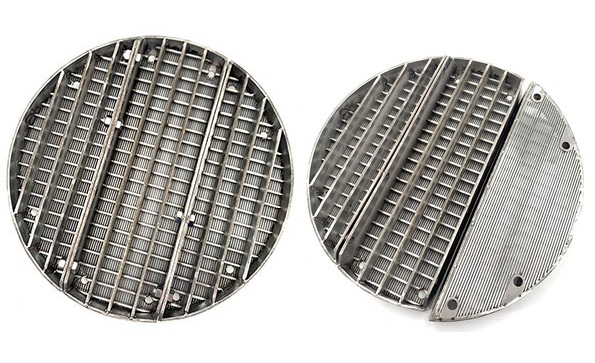
Wedge wire reactor support grids are widely used in:
• Fixed-bed catalytic reactors
• Hydrogenation and reforming units
• Ion exchange and resin-based systems
• Gas-liquid and liquid-solid separation vessels
In these systems, reliable support and consistent filtration have a direct impact on conversion efficiency and product quality.
| Aspect | Wedge Wire Support Grid | Traditional Mesh or Plate |
|---|---|---|
| Load Capacity | High, suitable for heavy catalyst beds | Limited under high loads |
| Slot Precision | Consistent, engineered slots | Variable opening size |
| Clogging Resistance | High due to V-profile | Higher risk of blockage |
| Service Life | Long-term industrial use | Shorter in harsh conditions |
| Maintenance | Low | Frequent inspection required |
Wedge wire reactor support grids provide a reliable answer to the mechanical and filtration challenges found in chemical plant reactors. Their strength, precision, and resistance to harsh environments make them well-suited for modern chemical processing demands.
As chemical plants continue to prioritize efficiency, safety, and long-term reliability, wedge wire support grids remain a proven and practical choice for reactor internals and filtration support.
Contact us
E-mail: sales@yubofilter.com
WhatsApp: 86 13653285589
Frequently Asked Questions (FAQ)
1. What materials are commonly used for wedge wire reactor support grids?
Most wedge wire reactor support grids are manufactured from stainless steel grades such as SS304, SS316, and SS316L. These materials provide excellent corrosion resistance, mechanical strength, and long service life in chemical plant applications.
2. How do wedge wire support grids reduce pressure drop in reactors?
The V-shaped wire profile creates continuous, non-blinding slots that minimize particle lodging. This design allows fluids to pass smoothly through the grid, reducing pressure drop buildup compared to flat or woven filtration media.
3. Are wedge wire reactor support grids suitable for high-temperature applications?
Yes. Stainless steel wedge wire support grids are well-suited for high-temperature reactor environments. Their welded construction maintains structural integrity and slot stability under thermal stress.
4. Can wedge wire support grids be customized for specific reactors?
Wedge wire reactor support grids can be customized based on reactor diameter, slot size, load requirements, and process conditions. Custom design ensures optimal catalyst support and flow distribution for each application. Custom Email: sales@yubofilter.com
5. What industries commonly use wedge wire reactor support grids?
These support grids are widely used in chemical processing, petrochemical refining, pharmaceutical manufacturing, and ion exchange systems where reliable catalyst retention and filtration are critical.
6. How long do wedge wire reactor support grids typically last?
When properly specified and installed, wedge wire reactor support grids can operate for many years with minimal maintenance. Their service life is significantly longer than conventional mesh supports in demanding chemical environments.
7. Do wedge wire support grids require frequent maintenance?
No. Due to their clog-resistant slot design and robust construction, wedge wire support grids generally require minimal maintenance compared to traditional support media.
8. How do wedge wire support grids contribute to overall plant reliability?
By preventing catalyst migration, maintaining stable flow, and reducing unplanned shutdowns, wedge wire reactor support grids improve operational reliability and lower long-term maintenance costs.



