
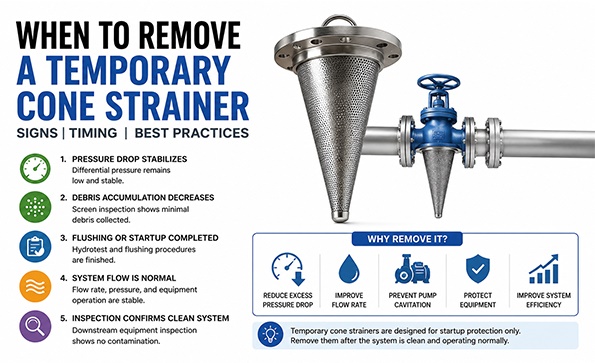
A temporary cone strainer should be removed after the pipeline startup or commissioning process is complete and the system is confirmed clean. Common indicators include stable pressure drop, reduced debris accumulation, and successful flushing or startup operation.
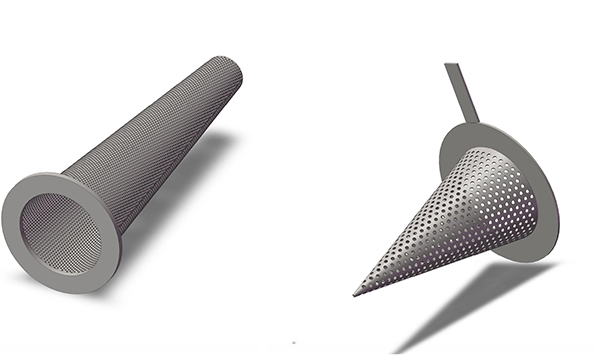
Temporary cone strainers, also called witches hat strainers, are installed during startup to protect pumps, valves, and other equipment from debris left inside pipelines.
Typical contaminants include:
• Weld slag
• Rust and scale
• Construction debris
• Gasket fragments
Without temporary filtration, these particles can damage sensitive equipment during the first stages of operation.
For a product complete guide, visit our Witches Hat Strainer Guide
No. Temporary cone strainers are designed for short-term use only.
Their primary purpose is to provide filtration during:
• Startup
• Flushing
• Commissioning
• Maintenance restart
Once the system becomes clean and stable, the strainer is usually removed to restore normal flow conditions.
Leaving a temporary cone strainer installed longer than necessary can create operational problems.
Potential issues include:
• Increased pressure drop
• Reduced flow rate
• Higher clogging risk
• Pump cavitation
• Reduced system efficiency
Because temporary strainers often use fine mesh to capture debris, they can become restrictive after debris accumulates.
1. Pressure Drop Stabilizes
One of the clearest indicators is stable differential pressure across the strainer.
During startup:
• Pressure drop usually increases as debris accumulates
• After flushing, pressure readings should stabilize
If pressure remains low and stable, the system is likely clean enough for removal.
2. Debris Accumulation Decreases
During inspection, the amount of trapped material should gradually decrease.
Typical startup debris includes:
• Welding residue
• Pipe scale
• Rust particles
When inspections show minimal debris collection, the temporary filtration stage is usually complete.
3. Startup or Flushing Procedure Is Completed
Most industrial projects define a flushing or commissioning sequence.
Temporary cone strainers are typically removed:
• After hydrotesting
• After flushing cycles
• Before normal production operation
Always follow project specifications and commissioning procedures.
4. System Flow Returns to Normal
Abnormal flow restriction may indicate that the strainer is still partially blocked.
Once the system operates at:
• stable flow rate
• normal pressure
• consistent equipment performance
the temporary strainer may no longer be necessary.
5. Equipment Inspection Confirms Clean Conditions
In critical systems, engineers may inspect:
• pump internals
• valves
• instrumentation
If no additional contamination is found, the temporary cone strainer can usually be removed safely.
| Application | Typical Removal Time |
|---|---|
| Pipeline startup | After flushing |
| Pump commissioning | After stable operation |
| Refinery systems | After debris inspection |
| Water treatment | After clean flow confirmation |
| Maintenance restart | After restart stabilization |
• Verify Differential Pressure
Check pressure readings before and after the strainer.
• Inspect the Screen
Examine collected debris to confirm contamination has reduced.
• Follow Commissioning Procedures
Always comply with plant or project startup protocols.
• Confirm Stable Equipment Operation
Ensure pumps, valves, and instruments are operating normally.
• Document the Removal
In industrial facilities, removal is often logged as part of commissioning records.
• Removing the Strainer Too Early
Residual debris may still damage downstream equipment.
• Leaving It Installed Indefinitely
Temporary strainers are not optimized for long-term operation.
• Ignoring Pressure Drop
A clogged temporary strainer can restrict flow significantly.
• Using Fine Mesh for Extended Operation
Fine mesh increases fouling risk during continuous use.
| Type | Purpose | Service Duration |
|---|---|---|
| Temporary Cone Strainer | Startup protection | Short-term |
| Y-Strainer | Continuous filtration | Long-term |
| Basket Strainer | High-capacity filtration | Long-term |
Related Reading: Heat Exchanger Startup Protection Using Temporary Cone Strainers
1. How long should a temporary cone strainer stay installed?
Usually only during startup or flushing operations until the system is confirmed clean.
2. What happens if a cone strainer is left in too long?
It may increase pressure drop, reduce flow, and create operational inefficiencies.
3. Can a temporary cone strainer be reused?
In some cases yes, depending on material condition and contamination level.
4. How do engineers know the system is clean?
By monitoring pressure drop, inspecting debris levels, and verifying stable equipment performance.
5. Is pressure drop the main indicator for removal?
It is one of the most important indicators, especially when combined with inspection results.
Temporary cone strainers are essential during startup because they protect pumps and process equipment from debris contamination. However, they are designed for temporary service only.
The correct removal time depends on several factors:
• stable pressure drop
• reduced debris accumulation
• completed flushing procedures
• normal system performance
Removing the strainer at the appropriate time helps restore efficient flow conditions while ensuring equipment protection during commissioning.



