Temporary cone strainers are widely used during heat exchanger startup and commissioning to capture debris such as weld slag, rust, and construction particles before they enter sensitive heat transfer equipment. Proper startup filtration helps prevent fouling, blockage, pressure drop issues, and premature equipment damage.
Heat exchangers are highly sensitive to contamination during commissioning.
Newly installed or modified piping systems often contain:
• Weld slag
• Rust and scale
• Gasket fragments
• Sand and construction debris
If these contaminants enter the heat exchanger, they may:
• Block narrow flow passages
• Reduce heat transfer efficiency
• Increase pressure drop
• Damage internal components
• Cause unplanned shutdowns
For this reason, temporary filtration is commonly used before normal operation begins.
Related cone strainer guide: Witches Hat Strainer Guide
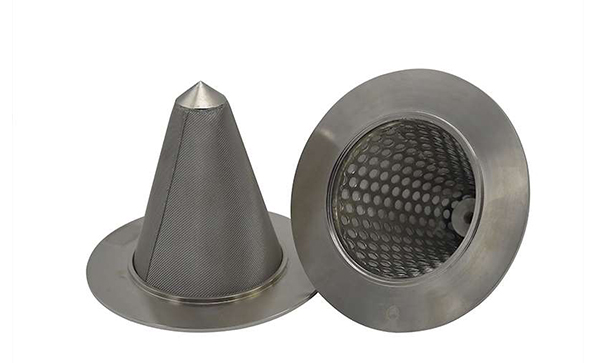
Temporary cone strainers, also known as witches hat strainers, are designed specifically for startup and commissioning applications.
They are installed temporarily in the pipeline upstream of the heat exchanger to remove debris during:
• Pipeline flushing
• System startup
• Equipment commissioning
• Maintenance restart
Unlike permanent strainers, temporary cone strainers provide:
• Large filtration area
• High debris holding capacity
• Easy installation between flanges
• Low installation cost
This makes them particularly suitable for short-term startup protection.
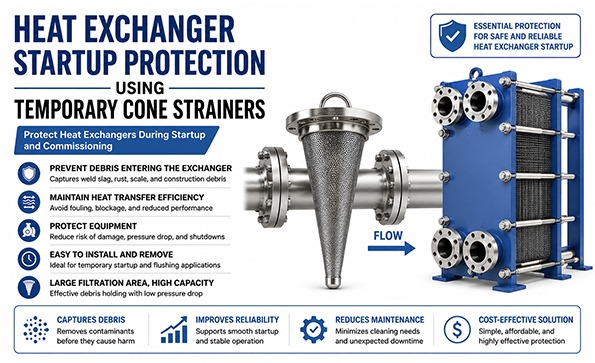
The operating principle is straightforward:
• Startup fluid passes through the cone strainer
• Debris is trapped by the mesh or perforated screen
• Cleaner fluid enters the heat exchanger
This temporary filtration stage helps reduce contamination before the system reaches stable operation.
| Risk | Potential Result |
|---|---|
| Weld slag entering exchanger | Tube blockage |
| Rust particles | Fouling and reduced efficiency |
| Construction debris | Damage to internal passages |
| Excessive contamination | Increased pressure drop |
| Debris accumulation | Maintenance downtime |
Even small particles may affect compact or high-efficiency heat exchanger designs.
In most systems, the temporary cone strainer is installed:
• upstream of the heat exchanger
• between pipeline flanges
• before startup circulation begins
The orientation depends on:
• flow direction
• debris load
• system design
Proper installation helps maintain stable flow conditions during commissioning.
Mesh size selection depends on:
• exchanger sensitivity
• expected debris size
• allowable pressure drop
Common recommendations:
| Mesh Range | Typical Use |
|---|---|
| 20–40 mesh | Heavy startup debris |
| 40–80 mesh | General commissioning protection |
| 80–100 mesh | Finer particle control |
In many startup applications, engineers prefer slightly coarser mesh initially to reduce clogging risk.
Using excessively fine mesh during startup may create:
• rapid clogging
• high differential pressure
• restricted flow
• operational instability
The goal is to balance:
• debris removal
• flow capacity
• startup efficiency
For this reason, temporary startup filtration often uses moderate mesh sizes instead of ultra-fine filtration.
Temporary cone strainers are generally removed after:
• flushing procedures are completed
• pressure drop stabilizes
• debris accumulation decreases
• the system reaches stable operation
Leaving the strainer installed longer than necessary may increase pressure drop and reduce system efficiency.
Related guide: When to Remove a Temporary Cone Strainer
| Type | Application | Service Duration |
|---|---|---|
| Temporary Cone Strainer | Startup protection | Short-term |
| Y-Strainer | Continuous filtration | Long-term |
| Basket Strainer | Large debris handling | Long-term |
Temporary cone strainers are intended for commissioning stages, not permanent filtration service.
In-depth Reading:
Temporary Strainer VS Permanent Strainer
Witches Hat Strainer vs Basket Filter
• Inspect Pipelines Before Startup
Mechanical cleaning reduces excessive debris load.
• Select Appropriate Mesh Size
Avoid using unnecessarily fine mesh during flushing.
• Monitor Differential Pressure
Pressure increase may indicate debris accumulation.
• Remove the Strainer After Startup
Temporary strainers should not remain installed indefinitely.
• Follow Commissioning Procedures
Always comply with plant startup specifications.
1. Why are temporary cone strainers used before heat exchangers?
They protect heat exchangers from debris contamination during startup and commissioning.
2. What mesh size is commonly used?
Typically 20–80 mesh, depending on system conditions and equipment sensitivity.
3. Can startup debris damage a heat exchanger?
Yes. Weld slag, rust, and construction particles may block or foul internal passages.
4. Are temporary cone strainers permanent filters?
No. They are designed for temporary startup service only.
5. When should the strainer be removed?
Usually after flushing and commissioning are completed and system conditions stabilize.
Heat exchangers are particularly vulnerable during startup because debris inside pipelines can easily enter and contaminate sensitive flow passages.
Temporary cone strainers provide a practical and cost-effective solution for commissioning protection by capturing startup debris before it reaches the exchanger.
Correct mesh selection, installation, monitoring, and timely removal all contribute to safer startup procedures and improved equipment reliability.



