
Choosing between SS304 and SS316L is a common decision when ordering a stainless steel cartridge filter housing. In most cases, the choice should be based on the process fluid, corrosion conditions, cleaning requirements, and project specifications—not simply on which material has the higher grade.
For general industrial filtration, SS304 may be sufficient. SS316L becomes more relevant when the process places greater demands on corrosion resistance, hygiene, or material compatibility.
Both SS304 and SS316L are widely used for stainless steel cartridge filter housings, but their chemical compositions are different.
The main difference is that SS316L contains molybdenum, which generally provides better resistance to chloride-related pitting and crevice corrosion than SS304. The "L" also indicates a low-carbon grade, which is relevant when the housing involves welded fabrication.
This does not mean that SS316L should replace SS304 in every application. The housing material still needs to match the actual process conditions.
In-depth Reading → Industrial Cartridge Filter Housing Guide
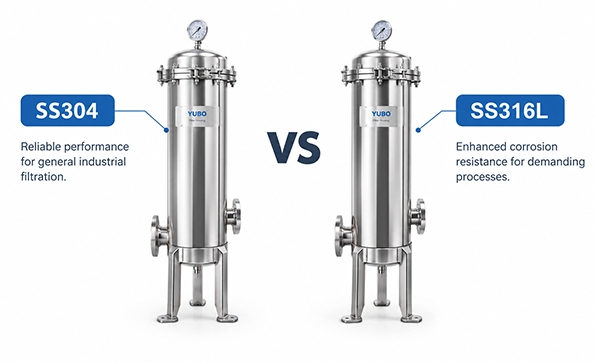
SS304 is commonly selected for cartridge filter housings used with compatible, relatively non-aggressive fluids and general industrial filtration.
It can be a practical option when:
• The process fluid is not highly corrosive.
• Chloride exposure is limited or adequately controlled.
• The cleaning process is compatible with SS304.
• The project specification does not require SS316L.
• The application does not need the additional corrosion resistance of 316L.
For these conditions, choosing SS316L simply because it is a higher-grade material may not provide a meaningful advantage.
YUBO supplies SS304 cartridge filter housings in single and multi-cartridge configurations. See Single vs Multi Cartridge Filter Housing for the differences between the two configurations.
SS316L is generally considered when the process environment is more demanding.
Typical considerations include:
• Chloride-containing or more corrosive process fluids
• Chemical processing applications
• Hygienic or higher-purity filtration
• More demanding cleaning conditions
• Project specifications that specifically require SS316L
For example, if the fluid or cleaning environment creates a higher corrosion risk for SS304, upgrading the housing material to SS316L may be appropriate.
However, SS316L alone does not automatically make a cartridge filter housing suitable for sanitary service. The connection design, surface finish, seals, internal construction, and overall system requirements still need to be considered.
| Factor | SS304 | SS316L |
| General industrial filtration | Common choice | Also suitable |
| Corrosive fluids | Requires careful review | Often considered |
| Chloride exposure | Requires evaluation | Better resistance in many conditions |
| Hygienic applications | Application dependent | Commonly selected |
| Cleaning conditions | Must be checked | Must be checked |
| Material cost | Generally lower | Generally higher |
| Project specification | Must meet requirements | Must meet requirements |
The important point is that material selection should start with the process, not the material grade.
A higher material grade does not automatically make a filtration system more suitable.
If SS304 is compatible with the process and meets the project requirements, moving to SS316L may add material cost without solving an actual filtration problem.
On the other hand, selecting SS304 only to reduce the initial purchase cost can create problems if the operating environment requires greater corrosion resistance.
For a cartridge filter housing, the practical question is therefore not "Which material is better?" but "Which material is appropriate for this service?"
Before placing an order, provide the manufacturer with the following information:
1. Process fluid – What liquid or gas will pass through the housing?
2. Chemical conditions – Are chlorides, acids, alkalis, solvents, or other corrosive substances present?
3. Operating temperature and pressure – These affect the housing and seal selection.
4. Cleaning method – Consider chemical cleaning, CIP, or other cleaning conditions where applicable.
5. Hygiene requirements – Important for food, beverage, pharmaceutical, and similar applications.
6. Project specification – Some projects specify SS304, SS316L, or other materials in advance.
7. Installation environment – The surrounding environment can also affect material selection.
These factors are also part of the wider cartridge filter housing selection process. See our How to Choose a Cartridge Filter Housing for more details. Providing this information allows the housing manufacturer to recommend the material based on the actual operating conditions rather than selecting a grade from the material name alone.
Yes. YUBO supplies cartridge filter housings in SS304 and SS316L, with customization available for different process requirements.
Depending on the application, the housing can be configured for different cartridge quantities and lengths, threaded, flanged, or clamp connections, customized inlet and outlet dimensions, pressure and temperature requirements, and different seal materials.
For OEM or project-based filtration systems, customers can also provide drawings or process requirements for housing configuration.
1. Can an existing cartridge filter housing be replaced with a different material grade?
Yes, but the replacement should be checked as a complete housing specification, including dimensions, connections, cartridge configuration, pressure and temperature requirements, and installation space.
2. Does changing from SS304 to SS316L change the cartridge filtration rating?
No. Housing material and cartridge filtration rating are separate considerations. The filtration rating is determined by the cartridge element.
3. Does SS316L eliminate the need to check seal material?
No. The housing material and seal material have different compatibility requirements. Seal selection should still consider the process fluid, temperature, pressure, and cleaning conditions.



